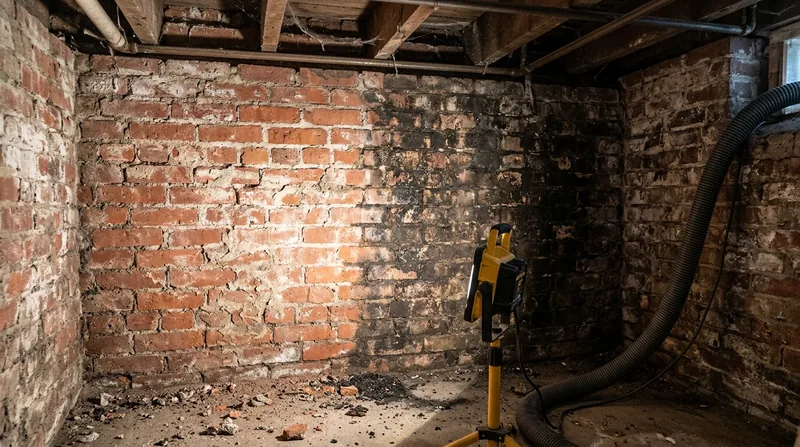




Basement Mold Remediation in New Haven starts with finding the water, not with spraying bleach. This city sits at the head of New Haven Harbor between East Rock and West Rock, and the traprock faces above East Rock and Prospect Hill shed storm runoff straight down onto streets and foundations below. Add glacial sand and till over a shallow water table in the harbor flats and floodplains along the Mill, Quinnipiac and West rivers, and you get basements that stay damp long after the rain stops. The older Italianate, Greek Revival and Queen Anne homes in Wooster Square and the Hill sit on brownstone and brick foundations laid with lime mortar, and that mortar wicks groundwater like a sponge. We pair containment and treatment of affected surfaces with the drainage or dehumidification fix that keeps mold from returning, and we start with a musty smell diagnostic. Call (475) 254-7661 or read our basement waterproofing service page before you tear anything out.
Why Mold Keeps Coming Back in New Haven Basements
Mold needs three things: moisture, organic material, and still air. New Haven basements supply all three. The 1880s to 1930s two-family homes and triple-deckers in Fair Haven and the Annex have full basements with old stone or brick walls, no vapor barrier, and rim joists that sweat through humid summers. The 1940s to 1960s Capes and ranches in Beaver Hills and Quinnipiac Meadows sit on block basements where the mortar joints weep after every nor'easter. And the 1980s to 2020s Colonials with poured-concrete basements in Hamden, North Haven, Branford and Guilford are tight enough that a failed sump pump or a clogged discharge line turns the whole space into a damp box in a weekend. The dominant failure mode here is not coastal fog. It is spring snowmelt and hard freeze-thaw cycles driving water through cracks and mortar joints, followed by humid summer air condensing on cold foundation walls.
- Water enters through hydrostatic pressure pushing against walls after the water table rises in the harbor flats.
- Efflorescence and white powder on the wall mean moisture is moving through the masonry right now.
- Musty basement smell is the first sign, often months before visible mold appears on joists or stored boxes.
- A sump pump that runs constantly, short-cycles, or fails during a storm leaves standing water that feeds mold growth within days.
Treating the mold without fixing the moisture source is a repeat job, and we tell homeowners that plainly on the first visit.
Key info: A Fair Haven triple-decker we inspected had mold on the lower three feet of a brick wall and a sump basin that was dry. The source was a collapsed section of footing drain under the rear addition. The mold came back twice for the previous owner because nobody scoped the drain.
For official guidance on moisture and mold in housing, the U.S. EPA maintains a plain-language resource at epa.gov/mold, and Connecticut homeowners can verify contractor registration through the state Department of Consumer Protection.
How We Run a Mold Remediation Job in New Haven
We work in a fixed order because skipping a step is how mold comes back. First we find the moisture source with a pin meter and a thermal camera, then we contain the work area, then we remove and treat affected material, then we correct the drainage or humidity problem, and finally we verify the space is dry before we close out. On brownstone and brick foundations in East Rock and Prospect Hill, that often means repointing with a lime-based mortar rather than a hard cement patch that traps water and spalls the face. On poured walls in Hamden and Branford, it usually means foundation crack repair with epoxy or polyurethane injection before any surface treatment.
- We inspect the basement, the exterior grade, the downspout extensions, and the sump discharge line to locate where water is actually entering.
- We set up containment with poly sheeting and negative air pressure so spores do not spread to the rest of the house during removal.
- We remove porous materials that cannot be cleaned (drywall, insulation, cardboard, rotted wood) and bag them on site.
- We HEPA-vacuum and treat structural surfaces with an antimicrobial product appropriate to masonry or wood.
- We correct the moisture source: drainage, crack injection, wall sealing, a vapor barrier, or a dehumidifier sized to the cubic footage.
- We verify with moisture readings and a visual walkthrough before we call the job complete.
Every job ends with a written summary of what we removed, what we treated, and what we changed to keep the basement dry.
Key info: In a 1920s Westville home, mold covered the back of the drywall on a furred-out wall. The wall was dry to the touch. The thermal camera showed a cold band along the rim joist where humid summer air was condensing. We removed the drywall, treated the framing, insulated and air-sealed the rim, and added a vapor barrier. No drainage work was needed.
Remediation and Moisture-Control Approaches We Use
The right approach depends on what is wet and why. A surface treatment alone is enough when the moisture source was a one-time event, like a burst supply line. It is never enough when groundwater is pushing through the wall. The table below shows how we match the method to the condition.
| Approach | Description | Best for |
|---|---|---|
| Containment and surface treatment | Poly sheeting, negative air, HEPA vacuuming, antimicrobial treatment of structural surfaces. | Light surface mold on joists, subfloor, or masonry where the moisture source has already been corrected. |
| Material removal and rebuild | Cut out and bag porous materials, treat framing, replace with moisture-resistant assemblies. | Mold behind drywall on furred walls, saturated insulation, or rotted rim joists. |
| Drainage correction | Interior perimeter drain, sump basin and pump, discharge line, footing drain repair. | Recurring wet walls or floor seepage after rain, especially in Fair Haven and the harbor flats. |
| Crack injection and wall sealing | Epoxy or polyurethane injection into poured-wall cracks, parging and sealing on masonry. | Isolated wall seepage on poured concrete in Hamden and Branford, or mortar-joint weeping on brick. |
| Humidity control | Sized dehumidifier, vapor barrier, air sealing at the rim, ventilation review. | Damp basements with no standing water, condensation on cold walls, and humid summer air in tight newer homes. |
We will tell you when a simple crack seal and a dehumidifier are enough, and when the real problem is hydrostatic pressure that needs an interior drain tile system.
Basement Mold Remediation Cost in New Haven: What to Expect
Most basement mold remediation jobs in New Haven start at From $1,500, and that figure covers a contained work area, removal of affected porous material, HEPA vacuuming, antimicrobial treatment, and a moisture verification. From there, the number moves with three things: how much material has to come out, how far the mold has spread, and what moisture fix the basement actually needs. A single furred-out wall in a Beaver Hills Cape is one scope. A full perimeter of wet brick in a Fair Haven triple-decker with a failed footing drain is another. We do not quote the remediation without pricing the moisture correction, because one without the other is a callback.
- Square footage of affected surface is the biggest single driver of labor and material cost.
- Access matters: a low-clearance basement or a finished lower level with stored contents takes longer to contain and clear.
- The moisture correction (drain tile, sump pump, crack injection, vapor barrier, or dehumidification) is priced separately and can exceed the remediation itself.
- Emergency response after a storm or a failed sump pump carries a premium over a scheduled job.
Get two or three written estimates and compare the scope line by line, not just the bottom number. Our full pricing overview shows how the line items break down.
Hiring a Basement Mold Remediation Contractor Near Me in New Haven
Ask three questions before anyone starts work. First, are you registered and insured in Connecticut, and can I see the certificate? Second, what moisture source did you find, and how will you correct it? Third, what does the written scope include and exclude? A contractor who quotes a treatment number without opening a wall or scoping the drain is guessing. Get at least two estimates, ask for references from jobs in New Haven or the surrounding towns, and confirm who pulls any permit the work requires.
- Verify the contractor's registration with the Connecticut Department of Consumer Protection and ask for a certificate of insurance naming you as certificate holder.
- Ask whether containment and negative air are included, since a treatment job without containment spreads spores through the house.
- Confirm the moisture correction is in the written scope, not listed as a future recommendation.
- Check whether a permit is needed: structural foundation repair, egress window cutting, and work that alters drainage or the sanitary connection of a sump discharge commonly require one, and thresholds vary by jurisdiction, so call the New Haven building department to verify before work starts.
We are a Basement Health Association member and we put the scope in writing before we move a single box. Reach out through our contact page to schedule a free basement inspection at (475) 254-7661.
Basement Mold Remediation in New Haven: Pricing Guide
| Service | Price | Details |
|---|---|---|
| Single-area surface remediation | Starting at $1,500 | Containment, HEPA vacuuming, antimicrobial treatment, and moisture verification for one affected wall or zone. |
| Material removal and rebuild | Starting at $2,800 | Cut-out and disposal of moldy drywall or insulation, framing treatment, and moisture-resistant rebuild in the affected area. |
| Remediation plus drainage correction | On estimate | Remediation paired with interior drain tile, sump pump, or crack injection; priced after the moisture source is confirmed on site. |
| Emergency response after flooding | On estimate | Priority scheduling after a storm or sump failure, with extraction and containment priced by affected square footage. |
| Travel | Included | In New Haven and surrounding towns, with no separate call-out or mileage fee added to the invoice. |
| Estimate | Free | Response within 24 hours at (475) 254-7661, with no obligation to book the work. |
Indicative pricing, the exact cost depends on square footage, finish, and site access. Free personalized estimate within 24h at (475) 254-7661.


