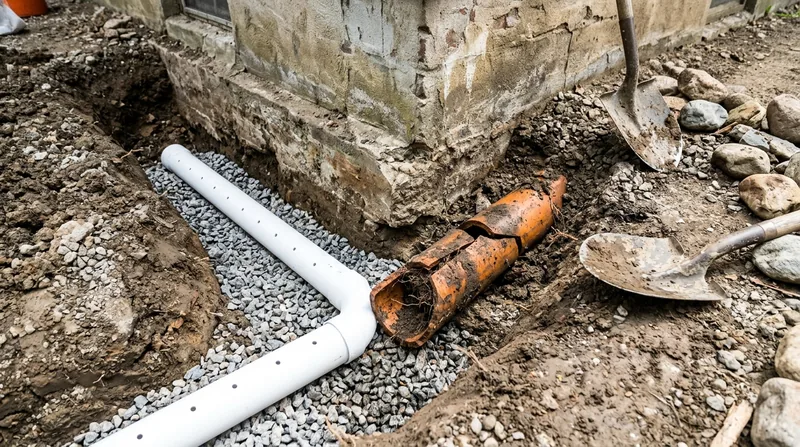




If your basement takes on water after every hard rain in New Haven, the problem is usually below the slab, not at the wall. Drain Tile Repair & Replacement in New Haven targets the footing drain that was supposed to carry groundwater away from your foundation and stopped doing its job years ago. In Fair Haven and the Hill, 1880s to 1930s two-family homes and triple-deckers still sit on original clay tile that has collapsed, silted up, or been choked by elm and maple roots. On the brownstone and brick foundations of East Rock and Prospect Hill, that same failed tile pushes hydrostatic pressure against old lime mortar until the walls seep and efflorescence blooms. We camera the line, find the break, and replace it with modern PVC that actually drains. Start with a free basement inspection so we can see what the tile is doing before anyone quotes a number.
Why Failed Drain Tile Is the Real Story Behind Wet Basements in New Haven
New Haven sits at the head of the harbor between East Rock and West Rock, and those traprock faces shed storm runoff straight onto the streets below. In the harbor flats, glacial sand and till sit over a shallow water table, and the Mill, Quinnipiac, and West river floodplains push groundwater up under slabs during nor'easters and spring snowmelt. When the footing drain is dead, that water has nowhere to go but into your basement.
- Original clay tile from the 1880s to 1950s cracks at the joints and fills with silt, so it stops carrying water entirely.
- Tree roots from street elms, oaks, and maples invade the line at the joints and choke flow down to a trickle.
- Collapsed sections under a settled slab create low spots where water pools instead of reaching the sump basin.
- Freeze-thaw cycles heave and shift shallow tile runs, opening new breaks every winter.
- Block-basement Capes in Beaver Hills and Quinnipiac Meadows wick water through mortar joints once the exterior drain fails.
In every one of these cases, sealing the wall alone will not fix it. The water still arrives, and it still needs a path out.
Key info: A 1920s triple-decker in Fair Haven with a wet floor after every storm is a classic dead-tile case. The wall looks fine, the floor is damp, and the original clay line under the slab is full of root mass. Camera inspection settles it in under an hour.
Permits for drainage work and sump discharge connections vary by jurisdiction, so confirm the current requirements with the City of New Haven building department before work begins.
How We Diagnose and Replace Drain Tile on New Haven Foundations
We do not dig first and ask questions later. The sequence starts with a camera run through the existing line to map breaks, root intrusion, and collapse, then a decision on whether targeted repair or full replacement is the honest answer. On poured-concrete Colonials in Hamden, North Haven, Branford, and Guilford, the tile is often shallow and accessible. On older brick and brownstone foundations, we work carefully around lime mortar and parging so the repair does not create a new seep point.
- We camera the existing footing drain and mark every break, root mass, and low spot on a sketch you keep.
- We open only the slab or exterior trench sections that actually need work, not the whole perimeter by default.
- We remove failed clay tile and root-bound sections and haul the debris out.
- We set new perforated PVC on proper gravel bedding with correct fall toward the sump basin.
- We tie the line into the sump basin, confirm the check valve, and test flow with water before backfilling.
- We restore the slab or trench and walk you through what the camera showed before and after.
If the surrounding walls are also taking water, we coordinate the tile work with an interior drain tile system so the perimeter is handled as one job instead of two.
Key info: A 1950s ranch in Westville had a sump pump running every 20 minutes during spring melt, and the pump was not the problem. The original clay tile had separated at three joints. We replaced 40 feet of line with PVC and the pump cycle dropped to normal storm response.
Repair Methods We Use on New Haven Drain Tile
Not every failed line needs the same treatment. The right approach depends on where the break is, how deep the tile sits, and whether the surrounding soil is glacial clay that holds water or sandy harbor fill that drains fast. Here is how the options compare on real New Haven properties.
| Approach | Description | Best for |
|---|---|---|
| Targeted spot repair | Open the slab at one confirmed break and splice in new PVC | A single collapsed joint on an otherwise flowing line |
| Sectional replacement | Replace a run of failed clay tile with perforated PVC on gravel | Root-bound or silted sections under 1880s to 1950s homes |
| Full perimeter replacement | New interior perimeter drain tied to the sump basin | Dead tile around the whole foundation with hydrostatic pressure |
| Exterior footing drain replacement | Excavate outside, replace tile, add membrane and dimple board | Shallow foundations with accessible exterior and heavy wall seepage |
| Camera-only diagnosis | Inspect and map the line before any digging decision | Any homeowner who needs to know if repair is even necessary |
The camera run comes first on every job, because guessing at a buried line is how homeowners end up paying for excavation they did not need.
Drain Tile Repair & Replacement Cost in New Haven: What to Expect
Pricing starts at $750 for a targeted spot repair where the camera has already located a single accessible break. From there, cost tracks the length of line being replaced, how deep the tile sits, whether the slab has to be cut, and whether root mass from a mature street tree has spread through the run. A short sectional replacement on a Beaver Hills ranch prices very differently from a full perimeter job under a Wooster Square brownstone.
Access is the other big variable. A line under a finished basement floor costs more to open than one under a bare slab, and exterior excavation on a narrow lot in the Annex takes more care than a wide suburban yard in Guilford. We give you the camera findings and a written scope before any number is final. Compare two or three estimates on the same scope, not on the headline price, because a low quote that skips the camera run is not the same job. Our full pricing overview breaks down the ranges in more detail.
Drain Tile Repair & Replacement Near Me: How to Vet a Contractor Near New Haven
Ask for the Connecticut license and a certificate of insurance before anyone touches your slab, and call the references on jobs that involved the same kind of foundation you have. A contractor who cannot explain why your tile failed, in plain terms, is guessing. We are a Basement Health Association member and we specialize in below-grade work, not general handyman repairs.
Permits for drainage alterations and sump discharge connections vary by jurisdiction, so confirm the current rules with the local building department before work starts. If your property sits in a historic district or has protected trees near the line, check those requirements early so the schedule does not stall. Get two or three written estimates on identical scope, and ask each one whether a camera inspection is included.
Ready to find out what is under your slab? Contact us for a free estimate and we will schedule the camera run at (475) 254-7661.
Drain Tile Repair & Replacement in New Haven: Pricing Guide
| Service | Price | Details |
|---|---|---|
| Targeted spot repair | Starting at $750 | Opens the slab at one camera-confirmed break and splices in new PVC, with flow test before backfill. |
| Sectional drain tile replacement | Starting at $1,800 | Replaces a failed run of clay tile with perforated PVC on gravel, priced by length and depth. |
| Full perimeter interior drain replacement | On estimate | New interior perimeter drain tied to the sump basin, scoped after camera inspection and slab access review. |
| Exterior footing drain replacement | On estimate | Excavation, new tile, waterproof membrane and dimple board, priced by depth and lot access. |
| Camera inspection and diagnosis | Included with repair | Maps breaks, root intrusion and collapse before any digging decision, with findings shared in writing. |
| Estimate | Free | Response within 24h at (475) 254-7661, no obligation to book the work. |
Indicative pricing, the exact cost depends on square footage, finish, and site access. Free personalized estimate within 24h at (475) 254-7661.


