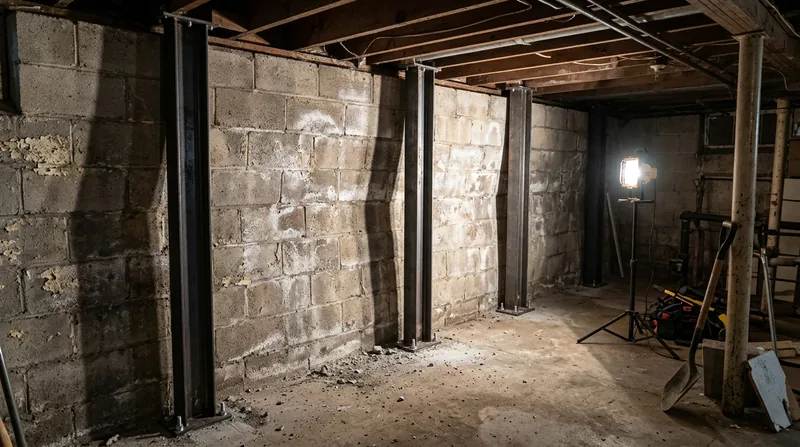




Bowing Wall Repair in New Haven starts with understanding what the ground is doing to your foundation. This city sits at the head of New Haven Harbor between East Rock and West Rock, traprock ridges that shed runoff onto the streets below. In the harbor flats, glacial sand and till sit over a shallow water table, and the Mill, Quinnipiac, and West rivers flood on a hard nor'easter. Older brick and brownstone foundations in Wooster Square, East Rock, and Prospect Hill were laid with lime mortar that softens over time, and block basements in Beaver Hills and Quinnipiac Meadows take frost push every winter. When saturated till and freeze-thaw cycles push a wall inward, the wall bows, and the fix is structural. We match carbon fiber straps, steel I-beams, or wall anchors to the severity of the movement and your soil, and we start with a free basement inspection so you know exactly what you are dealing with.
Why Bowing Walls Are a New Haven Problem, Not a Cosmetic One
A bowing wall is a wall that is moving, and movement does not stop on its own. In New Haven, the pressure comes from hydrostatic pressure in saturated glacial till, from frost push during hard freeze-thaw cycles, and from old lime mortar that has lost its grip after a century of wet winters. A horizontal crack at mid-wall, a wall that leans in at the top, or a floor joist pulling away from the block are all signs the wall is under load.
- Horizontal cracking in the second or third block course from the top usually means soil pressure is pushing the wall inward.
- Stair-step cracking at the corners points to differential settlement, often where an addition meets the original foundation.
- Doors and windows that stick on the main floor can signal the wall is moving enough to distort the frame above.
- White efflorescence and damp patches on the block mean water is moving through the wall, not just sitting outside it.
- A wall that is visibly out of plumb by more than an inch over eight feet needs a structural repair, not a coat of sealer.
If you see any of these, get the wall looked at before the next spring snowmelt, because movement accelerates once a wall is out of plumb.
Key info: A 1920s two-family in Fair Haven with a full block basement and a mid-wall crack is a classic case. The wall was built before modern footing drains, the soil behind it is saturated till, and the crack opened over several winters. That wall needs stabilization, not a patch.
For the official word on structural permits and inspection requirements, check the City of New Haven building department before any structural work begins: New Haven Office of Building Inspection and Enforcement.
How We Stabilize a Bowing Wall in New Haven
We do not guess at a repair method from the driveway. We measure the wall, map the cracks, check the soil and drainage on the outside, and then pick the method that matches the load. A wall that has moved less than two inches usually takes carbon fiber straps. A wall that has moved further, or where the soil is heavy clay, takes steel I-beams or wall anchors driven into stable soil outside the failure zone.
- We inspect the wall, the footing, and the exterior grade, and we note where downspouts and grading are sending water against the foundation.
- We measure the deflection and plumb of the wall so the repair is matched to the actual movement, not a rule of thumb.
- We install carbon fiber straps, steel I-beams, or wall anchors, and we tie them into the floor framing and footing as the method requires.
- We address the water source with foundation waterproofing so the repaired wall is not fighting the same saturated soil next season.
- We document the repair and leave you with a transferable warranty on the stabilization work.
The goal is a wall that is held in place and a water path that is redirected, because a strap on a wet wall is a temporary answer.
Key info: On a 1950s ranch in Hamden with a poured-concrete basement, a wall had bowed about an inch and a half. We installed carbon fiber straps on twelve-inch centers and extended the downspouts six feet out. Two winters later the wall had not moved, and the basement stayed dry through the March thaw.
Repair Methods We Use and When Each One Fits
There is no single fix for a bowing wall, and the wrong method wastes money. The table below shows how we match the approach to the wall, the soil, and the amount of movement.
| Approach | Description | Best for |
|---|---|---|
| Carbon fiber straps | Straps bonded to the interior face and anchored top and bottom to resist further inward movement. | Walls with less than two inches of deflection and sound block. |
| Steel I-beams | Vertical beams set against the wall and tied into the floor and footing to brace the wall. | Heavier movement, long walls, and block walls with multiple cracks. |
| Wall anchors | Anchor plates set in stable soil outside and connected through the wall to interior plates. | Walls that need to be pulled back toward plumb where exterior access allows. |
| Crack injection plus stabilization | Epoxy or polyurethane injection seals active cracks after the wall is stabilized. | Walls with water coming through the crack as well as movement. |
We pick the lightest method that will hold the wall, because overbuilding costs you money and underbuilding costs you the wall.
Bowing Wall Repair Cost in New Haven: What to Expect
Most bowing wall repairs in New Haven start at $600 for a limited stabilization scope, such as a small number of carbon fiber straps on a wall with minor movement. From there, the price climbs with the length of the wall, the method, and how much excavation the anchors require. A full wall of steel I-beams on a triple-decker in the Hill costs more than a dozen straps on a ranch in Beaver Hills, and the difference is labor and material, not markup. See the full pricing overview for the line items we work from.
- The length and height of the bowed wall drive the number of straps or beams and the material cost.
- The repair method matters: carbon fiber is the least invasive, while wall anchors need exterior excavation and stable soil to bite into.
- Access to the basement and the exterior affects labor, especially in dense blocks of Fair Haven and Wooster Square.
- Whether the water source needs correction at the same time adds scope, and skipping it usually means a second repair later.
- Structural permits, where the local building department requires them, add a step to the schedule.
Get two or three written estimates on the same scope so you can compare method, not just the bottom line.
What to Look for When Hiring a Bowing Wall Repair Contractor Near Me in New Haven
Ask for proof of licensing and insurance before anyone touches the wall, and get a certificate of insurance sent directly from the carrier. Ask how the contractor measures the wall and how they choose the method, because a firm that quotes a repair without measuring deflection is guessing. Ask for references from jobs in New Haven or the surrounding towns, and call them. Ask who pulls the structural permit and whether the local building department requires one for your scope. We are a Basement Health Association member and we will tell you when a crack is a crack and when the wall is actually moving. Reach us through the contact page to set up an inspection.
For homes in Branford, Wallingford, Cheshire, Meriden, or Guilford, the same rules apply, and the local building department in each town has the final say on permits. We work across the area and we know the building stock: 1880s two-families, 1940s Capes, and 1990s Colonials all fail in different ways, and the repair should reflect that.
Bowing Wall Repair in New Haven: Pricing Guide
| Service | Price | Details |
|---|---|---|
| Carbon fiber strap stabilization (limited scope) | Starting at $600 | Covers a small number of straps on a wall with minor movement; wall length and strap count move the price. |
| Steel I-beam wall bracing | Starting at $1,800 | Vertical beams tied into floor and footing; number of beams and wall height drive the total. |
| Wall anchor system | Starting at $2,500 | Includes exterior excavation for anchor plates; soil condition and access determine the final number. |
| Crack injection plus stabilization | On estimate | Combines epoxy or polyurethane injection with the structural method; needs an on-site look at the crack activity. |
| Travel | Included | In New Haven and surrounding areas, no separate call-out or mileage fee. |
| Estimate | Free | Response within 24h at (475) 254-7661, no obligation to book. |
Indicative pricing, the exact cost depends on square footage, finish, and site access. Free personalized estimate within 24h at (475) 254-7661.


