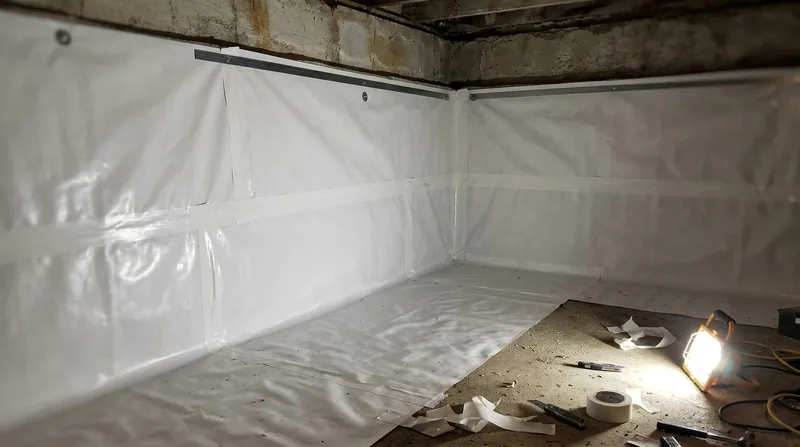




New Haven sits at the head of the harbor between East Rock and West Rock, and that geography decides how much moisture your basement deals with. The traprock ridges shed runoff onto the streets below, the harbor flats sit on glacial sand and till over a shallow water table, and the Mill, Quinnipiac and West river floodplains push groundwater up against 1820s Italianate and Queen Anne foundations on brownstone and brick with old lime mortar. Vapor Barrier Installation in New Haven is the below-grade answer to the ground vapor that rises through damp shoreline soil and keeps a lower level musty long after the visible water is gone. We install heavy-duty barrier sheets on basement walls and the slab, seal the seams, tape the terminations and tie the system into the sump where the floor needs it. If you are still chasing the source of the water itself, start with our basement waterproofing service and we will tell you honestly which layer of the problem you are looking at.
Why Vapor Barrier Installation Matters in New Haven's Older and Harbor-Flat Basements
Ground vapor is not the same problem as a running leak, and in New Haven it is the one that lingers. Brownstone and brick foundations in East Rock, Prospect Hill and Wooster Square were laid with lime mortar that stays damp, and the glacial clay soil over a shallow water table in Fair Haven, the Hill and the Annex keeps feeding moisture vapor through the wall and slab year round. That vapor condenses on cool foundation walls, lifts paint, blooms efflorescence and leaves the musty basement smell that tells you moisture is still moving.
- We block vapor at the wall and slab surface so the basement stays dry between rain events, not just during them.
- We seal every seam and tape every termination, because an open lap lets as much vapor through as bare concrete.
- We integrate the barrier with the sump basin and discharge line where the floor needs a drainage path.
- We leave the assembly breathable where old lime mortar walls need to dry inward, instead of trapping moisture in the brick.
Done right, the barrier is the difference between a basement you can use and one you avoid, and it pairs naturally with the moisture control work that keeps mold growth from returning.
Key info: A 1920s two-family in Fair Haven on a full basement often shows damp walls and a white bloom at the mortar joints with no visible crack. That is vapor drive through the foundation, not a leak, and a sealed heavy-duty barrier on the wall and slab is the correct fix before anyone starts excavating.
For the code and permit side of below-grade work in Connecticut, the state's official resource is the Department of Consumer Protection, and your local building department has the final word on anything that alters drainage.
How We Install a Vapor Barrier in a New Haven Basement
We start by reading the foundation, not by unrolling plastic. On a 1940s Cape in Beaver Hills with a block basement, the plan is different from an 1880s triple-decker in the Hill with a rubble and brick wall, and different again from a 2000s Colonial in Hamden with poured concrete. The walkthrough tells us where the vapor is coming from, whether the slab is damp, and whether the floor already has a drain path we need to tie into.
- We inspect the walls and slab for seepage, efflorescence and prior patching, and we note where the water table is affecting the floor.
- We correct active leaks first, because a barrier over a wet wall traps the problem instead of solving it.
- We clean and prep the surface so the adhesive and tape actually bond to the masonry.
- We hang and mechanically fasten the heavy-duty sheet on the walls, lapping the seams in the direction moisture travels.
- We lay and seal the slab membrane, taping terminations at the cove and perimeter.
- We integrate the barrier with the sump basin and check valve where the design calls for it, then test the assembly before we leave.
Every job ends with a walkthrough so you know what was sealed, what was left open on purpose, and what to watch for after the next nor'easter.
Key info: In a Guilford colonial on poured concrete, we found the slab wicking moisture from the shallow water table with no wall seepage at all. We sealed the slab, tied the membrane into the existing sump basin, and the musty smell cleared without touching the walls. That is the diagnostic value of a proper walkthrough.
If the inspection shows the floor needs drainage before a barrier goes down, we handle that with an interior drain tile system and then return to the barrier.
Vapor Barrier Approaches We Use Below Grade
Not every basement needs the same assembly, and the right choice depends on wall type, floor condition and how much hydrostatic pressure the site carries. The table below shows the approaches we specify most often in New Haven residential work.
| Approach | Description | Best for |
|---|---|---|
| Wall sheet barrier | Heavy-duty sheet fastened to the wall with sealed seams and taped terminations. | Brick and block walls with damp surfaces and efflorescence. |
| Slab membrane | Sheet laid over the floor, sealed at the cove and perimeter. | Damp slabs over a shallow water table in harbor flats. |
| Dimple board drainage mat | Drainage mat that lets water travel to the perimeter drain while blocking vapor. | Walls with active seepage that also need a drainage path. |
| Sump-integrated barrier | Barrier tied into the sump basin, check valve and discharge line. | Floors that collect water and need controlled removal. |
| Breathable assembly for old lime mortar | Barrier detail that blocks ground vapor without trapping moisture in soft brick. | 1820s to 1910s brownstone and brick foundations. |
We pick the assembly after the inspection, not before, because the wrong barrier on an old lime mortar wall can do more harm than good.
Vapor Barrier Installation Cost in New Haven: What to Expect
Most residential vapor barrier work starts from $3 per square foot, and that figure covers the sheet, the fasteners, the seam sealing and the taped terminations. What moves the number is the condition of the foundation and how much prep the surface needs. A poured concrete wall in a 1990s Branford colonial is a straightforward install. A rubble and brick wall in Wooster Square with failing parging, or a slab that needs a sump tie-in first, takes more labor and more material.
Square footage is the biggest driver, followed by wall height, the number of corners and penetrations, and whether the floor needs drainage before the membrane goes down. Access matters too: a full basement with a wide bulkhead is easier than a tight interior stair in a triple-decker. Getting two or three estimates is smart, not because the cheapest wins, but because it tells you whether a contractor is pricing the prep and the sealing or just the plastic. Our full pricing overview breaks down the ranges we work from.
Hiring a Waterproofing Contractor Near New Haven: What to Check
Basement work is easy to sell and hard to do right, so the vetting matters more than the quote. Ask for the Connecticut registration and the insurance certificate, and actually read them. Ask how the contractor handles old lime mortar walls, because a crew that only knows poured concrete will trap moisture in a Wooster Square brownstone. Ask for references from jobs like yours, not just the newest build in the portfolio.
Permits are commonly required for structural foundation work and for anything that alters drainage or the sanitary connection of a sump discharge, and thresholds vary by jurisdiction, so confirm with the local building department before work starts. Get two or three written estimates that specify the prep, the material and the sealing method. Then call us at (475) 254-7661 or use the contact page to book a free basement inspection and get a straight answer on whether a barrier is the right next step.
Vapor Barrier Installation in New Haven: Pricing Guide
| Service | Price | Details |
|---|---|---|
| Wall vapor barrier | Starting at $3/sq ft | Includes heavy-duty sheet, fasteners, sealed seams and taped terminations on prepared walls. |
| Slab vapor barrier | Starting at $3/sq ft | Includes floor membrane, cove sealing and perimeter taping over a cleaned slab. |
| Sump-integrated barrier | On estimate | Ties the barrier into the sump basin and check valve, priced after the floor is inspected. |
| Old masonry prep and parging repair | On estimate | Extra labor for failing parging and soft brick that must be stabilized before the sheet goes up. |
| Travel | Included | In New Haven and surrounding towns, with no separate call-out or mileage fee. |
| Estimate | Free | Response within 24 hours at (475) 254-7661, with no obligation to book. |
Indicative pricing, the exact cost depends on square footage, finish, and site access. Free personalized estimate within 24h at (475) 254-7661.


