Why Homes Below East Rock and West Rock Get Wet Basements
If you live in the neighborhoods that sit at the foot of East Rock or West Rock, you already know something that flat-lot homeowners do not: water does not stay where it falls. Rain that lands high on the trap rock ridges starts moving downhill almost immediately, and it picks up speed and volume as it goes. By the time it reaches the streets and yards below, it is carrying far more water than your soil can absorb, and that water is looking for the path of least resistance. All too often, that path leads to your foundation.
This is the core of the ridge runoff problem in New Haven. The city's geology makes it worse. Much of the ground around the ridges is shallow soil over tilted bedrock, so water cannot soak down evenly. Instead it sheets across the surface or moves through thin seams in the rock, concentrating in low spots and against foundation walls. A homeowner on a gentle slope may never see standing water in the yard, yet still find a damp basement after every heavy storm, because the water is arriving underground and under pressure.
How Ridge Runoff Actually Reaches Your Foundation
The journey from ridge to basement happens in three main ways, and most wet basements involve more than one. First, surface runoff follows the grade of your lot. If your yard slopes toward the house, or if a neighbor uphill has a driveway or patio that sheds water your way, that water pools against the foundation and seeps through cracks, mortar joints, and the porous concrete itself. Second, subsurface flow moves through soil and rock. When the ground above your home is saturated, hydrostatic pressure builds against the foundation wall, and water finds its way through even hairline cracks. Third, older homes in these neighborhoods often have footing drains and downspouts that connect directly to the city sewer or to clay tile lines that have collapsed or clogged over decades.
That last point matters more than many homeowners realize. A downspout that empties into a broken clay leader line is essentially dumping roof water right next to your footing. During a heavy rain, the system backs up and releases water exactly where you least want it. This is why a Foundation Waterproofing assessment always starts with the water's path, not just the crack in the wall. Fixing the crack without redirecting the runoff is a temporary patch at best.
Hillside Drainage Basement Problems: Signs You Should Not Ignore
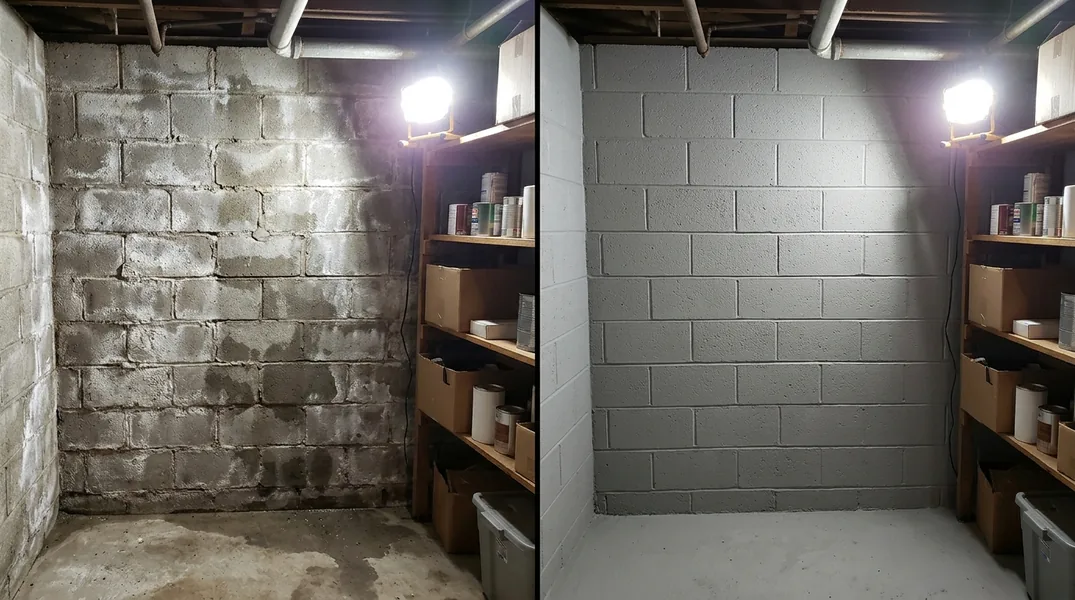
Hillside and slope-adjacent homes tend to show specific warning signs. You might notice efflorescence, that white powdery residue on the wall, which means water is moving through the concrete and leaving minerals behind as it evaporates. You might smell a musty odor in a finished or semi-finished basement, or see paint peeling and drywall staining near the floor line. In more advanced cases, you will see actual water on the floor after storms, rusted anchor bolts, or doors and windows that stick because the foundation has shifted slightly under pressure.
What makes ridge runoff different from ordinary groundwater is timing. Water from East Rock and West Rock arrives fast and in bursts. A basement that stays dry during a slow, soaking rain can flood during a 20-minute downpour, because the volume overwhelms the drainage all at once. If your leaks seem tied to intensity rather than total rainfall, that is a strong signal you are dealing with New Haven ridge runoff rather than a simple high water table. Homeowners in nearby Branford and Wallingford see similar patterns wherever homes sit below a slope, so the diagnostic approach is the same.
Basement Drainage Solutions That Work on Sloped Lots
The right fix depends on where the water is coming from, but most hillside homes benefit from a layered approach. Start outside: gutters and downspouts should discharge well away from the foundation, ideally to a dry well or a graded swale that carries water around the house rather than past it. Regrading the soil so it slopes away from the walls is inexpensive and often surprisingly effective. Where surface water is the main culprit, Exterior Basement Waterproofing addresses the problem at its source by sealing the exterior wall and improving drainage at the footing.
When water is already arriving under pressure or through the wall itself, interior solutions take over. An Interior Drain Tile System installed along the inside of the footing captures water as it enters and routes it to a sump pump, keeping the basement floor dry even during the heaviest ridge runoff events. Many homes need both interior and exterior work, plus targeted crack injection, and a thorough Basement Waterproofing plan will prioritize the fixes that give you the most protection for your budget.
Basement Waterproofing Near Me: When to Call a Professional in New Haven
Some drainage improvements are genuinely DIY-friendly, like extending downspouts and adding soil to slope the grade. But if you have tried those steps and still get water after storms, or if you see bowing walls, widening cracks, or repeated flooding, it is time for a professional evaluation. Ridge runoff problems are often invisible from the surface, and guessing at solutions can mean paying twice. A proper inspection looks at the slope of your lot, the condition of your footing drains, the age of your foundation, and how water moves through your specific soil and rock.
New Haven Waterproofing works with homeowners across the area, including Cheshire and surrounding communities, and we understand how the local ridges shape drainage. We will walk your property, explain what we find in plain language, and recommend a plan tailored to your home rather than a one-size-fits-all package. If you would like to understand what a project might involve, you can review our pricing information or call us at (475) 254-7661 to schedule a free estimate. A dry basement is easier to achieve when you address the runoff at its source, and the sooner you act, the less damage you will have to repair.
Looking for a professional basement waterproofing contractor in New Haven? New Haven Waterproofing responds fast for all your basement waterproofing needs.
Get a Free QuoteOur services: Basement Waterproofing · Interior Drain Tile System · Exterior Basement Waterproofing